- Home
- About Liya
- Liya Boats
- Luxury RIB Boats-Fiber Hull
- 8.3m/27Ft Cabin RIB Boat
- 8m/26Ft Sport Fiber RIB Boat
- New 7.5m/25Ft luxury Italy style RIB Boat
- Classic 7.5m/25Ft Rigid Inflatable Boat
- New 6.6m/22Ft Sport RIB Boat
- Classic 6.6m/22Ft Inflatable RIB Boat
- 6.2m/20Ft RIB Fishing Boat
- 5.8m/19Ft Fiberglass hull RIB
- 5.2m/17Ft RIB Boat
- 4.3m/14Ft Yacht Tender RIB Dinghy
- 4.3m/14Ft Center Console RIB Boat
- 3.8m/12.5Ft High Speed RIB Tender
- 3.3m/11Ft RIB Dinghy
- 8.3m/27Ft Cabin RIB Boat
- Open Deck RIBs-Fiber Hull
- Aluminum Hull RIB Boats
- 8-10M Aluminum Patrol RIB
- 7m/23Ft Aluminum RIB Yacht Tender
- 6.6m/22Ft Rigid Aluminum Hull RIB Boat
- 6.2m/20Ft Aluminum RIB Boat with Motor
- 5.8m/19Ft Aluminum Hull RIB Tender Boat
- 5.8-7.5M Transportation RIB
- 5.2m/17Ft Aluminum RIB Center Console Boat
- 4.3m/14Ft Aluminum RIB Dinghy For Sale
- 2.4-5.2m/8-17Ft Aluminum RIB Dinghy
- 8-10M Aluminum Patrol RIB
- Work RHIB-Rescue & Patrol RIBs
- 27Ft Aluminum Patrol Boat Polyurea-EVA Collar Deep-V Hull
- 9-10m/29-34Ft Aluminum Patrol RIB Boat
- Professional 8.3m Heavy-Duty Patrol RIB Boat|Fast-Response,12-Person,CE Certified
- 7.9m/26Ft RHIB for Patrol
- 6.6m/22Ft Black RIB Boat
- 5.8-7.5m/19-25ft Heavy Duty RIB Patrol & Work Boat
- 5.8-7.5m/19-25Ft Aluminum RIB Work Boat
- 27Ft Aluminum Patrol Boat Polyurea-EVA Collar Deep-V Hull
- Fiberglass Boats/Fishing Boats
- 7.6m/25Ft Fiberglass Panga Boat for Fishing
- Liya 45ft Fiberglass Cabin Fishing Boat Passenger Tour Vessel
- 9.18m/30Ft Fiberglass Cabin Fishing Boat
- 6.6m/22Ft Fiberglass Panga Skiff Boat
- 6m/20Ft Center Console Fishing Boat
- 5.8m/19Ft Center Console Panga Fishing Boat
- 5m/16.5Ft Economical Fiberglass Boat
- 7.6m/25Ft Fiberglass Panga Boat for Fishing
- Ferry & Transportation Boats
- Fully Inflatable Boats
- Luxury RIB Boats-Fiber Hull
- Application
- Hot Sale
- News
- Feature & Service
- Work RHIBs
- Contact Liya

Inquire
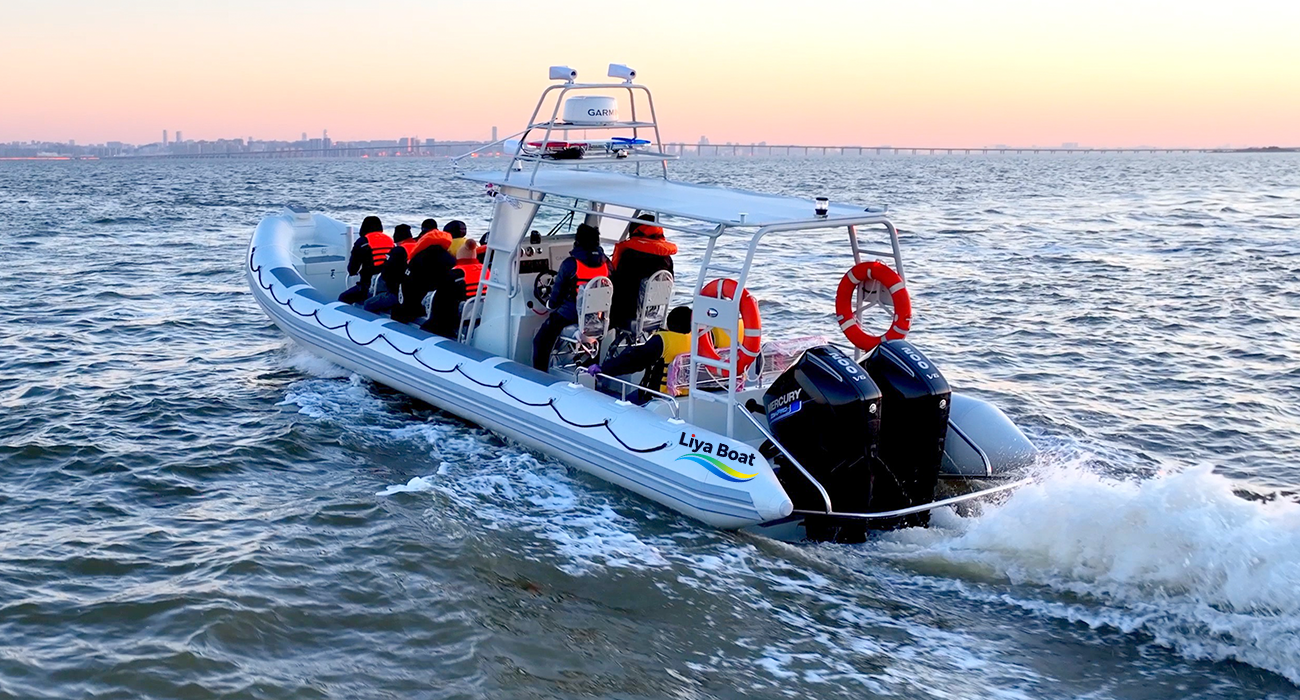
A custom inflatable RIB (Rigid Inflatable Boat) combines a rigid hull — typically 5083 marine-grade aluminum or hand-laid fiberglass (GRP) — with pressurized buoyancy tubes made from Hypalon (CSM) or PVC-coated fabric. Proper specification of these three systems — hull geometry, tube material, and internal chamber architecture — determines whether your vessel achieves 20 years of operational life or degrades within five.
Table of Contents
What Makes a RIB Boat "Custom"?
Hull Material Selection: Aluminum vs. Fiberglass (GRP)
Floor Systems: Inflatable, Slatted, and Aluminum Drop-In
Tube Material Science: Hypalon vs. PVC
Seam Construction and Structural Bonding Methods
Internal Chamber Architecture and Safety Engineering
Mission-Specific Configurations: Family, SAR, Military, and Dive
Console and Electronics Integration
Engine Selection and Transom Specifications
Total Cost of Ownership (TCO) Framework
How to Evaluate a Custom RIB Manufacturer
Maintenance Schedule by Material Type
FAQ
1. What Makes a RIB Boat "Custom"?
A production RIB boat is manufactured to a fixed template — fixed hull length, fixed tube diameter, fixed deck layout. A custom inflatable RIB boat is engineered from the design stage around a specific operational profile: the water conditions it will operate in, the number of passengers it must carry safely, the propulsion system it must support, and the regulatory framework it must satisfy.
This distinction matters commercially because a vessel optimized for Mediterranean charter work shares almost no component-level specification with a vessel built for Arctic Search and Rescue. Treating them interchangeably leads to premature material failure, inflated insurance premiums, and poor resale value.
Custom manufacturing typically encompasses six decision layers:
Hull material and deadrise geometry, tube material and fabric weight, floor system, chamber configuration, deck hardware and electronics, and engine bracket/transom specification. Each layer has cascading effects on the others. Getting the sequence right is the foundation of a cost-effective build.
2. Hull Material Selection: Aluminum vs. Fiberglass (GRP)
The hull is the structural spine of your vessel. It determines handling characteristics, long-term durability under stress, and the range of shapes a manufacturer can physically achieve.
Marine-Grade Aluminum (5083 Alloy)
5083-H116 aluminum alloy is the dominant material in professional and commercial RIB construction for measurable reasons. Its tensile strength of approximately 317 MPa makes it highly resistant to the repeated impact loads generated by high-speed transit in open water. The alloy's magnesium content (4.0–4.9%) provides inherent corrosion resistance in saltwater without anodizing — a critical property for vessels that spend extended time submerged or in splash zones.
Aluminum hulls are built through CNC plate cutting and precision TIG or MIG welding. This manufacturing process constrains design freedom — compound curves require additional fabrication steps — but it delivers extremely consistent structural tolerances. For operators who regularly beach their vessel on gravel or rocky shorelines, aluminum's dent-and-bounce recovery is operationally superior to any composite material.
Weight is the key performance advantage. A well-engineered 6-meter aluminum RIB hull typically weighs 30–40% less than an equivalent GRP hull. Reduced displacement translates directly into lower fuel consumption, higher top speeds with equivalent horsepower, and easier trailering with a smaller tow vehicle.
From a lifecycle perspective, aluminum hulls are fully recyclable and retain significant scrap value at end of life, which matters for operators calculating total asset cost over a 25-year fleet horizon.
Fiberglass (GRP) — Hand-Laid and Infusion
Glass-Reinforced Plastic (GRP) hulls are manufactured using either hand layup or vacuum infusion processes. Hand layup gives builders flexibility in applying localized reinforcement — extra cloth around the transom, keel, and chine — but introduces human variability in resin-to-glass ratios. Vacuum infusion produces more consistent laminate quality with lower void content, typically 2–5% versus 10–15% in hand layup, resulting in higher structural stiffness per unit weight.
The primary advantage of GRP is design freedom. Using Computational Fluid Dynamics (CFD) software and female molds, engineers can achieve hull shapes impossible with plate aluminum. Deep-V hulls with 24° to 28° deadrise angles, integrated strakes, and molded spray rails are routinely produced in fiberglass, delivering measurably better offshore performance in steep chop.
GRP also allows the deck, console base, and seating structures to be molded as a single continuous piece. This eliminates the mechanical fastener penetrations required in aluminum builds — each penetration point being a potential corrosion initiation site. The result is a more watertight, aesthetically refined vessel.
The tradeoff is impact vulnerability at the gelcoat surface. A hard grounding event that aluminum deflects can crack GRP laminate. Repair requires grinding, filling, and refinishing — more labor-intensive than aluminum welding.
Hull Comparison by Application
| Specification | 5083 Marine-Grade Aluminum | Fiberglass GRP (Vacuum Infused) |
Tensile Strength | ~317 MPa | ~250–350 MPa (layup-dependent) |
Weight (6m hull blank) | 90–110 kg | 130–160 kg |
Deadrise Design Range | Up to ~22° (plate bending) | Up to 28°+ (molded) |
Impact Recovery | High (deforms, does not crack) | Moderate (cracks under impact) |
Corrosion Resistance | Excellent (5083 alloy) | Excellent (gel coat protected) |
Repair Complexity | Low (TIG welding) | Moderate (laminate repair) |
Recyclability | 100% recyclable | Very limited |
Ideal Use Case | Commercial, SAR, beaching | Charter, luxury, high-speed offshore |
3. Floor Systems: Inflatable, Slatted, and Aluminum Drop-In
Floor specification is frequently overlooked in buyer guides, yet it directly impacts rigidity underfoot, deck drainage, and total vessel weight. Custom RIB manufacturers offer three principal options.
An inflatable floor (also called a high-pressure air floor or HPAF) is the lightest option and folds flat for compact storage. It is appropriate for tender and leisure applications but lacks the rigidity required for heavy commercial use or standing work platforms.
Slatted floors use interlocking panels of UV-stabilized polypropylene or marine plywood laminated in GRP. They provide good underfoot feel and allow water drainage between slats. Polypropylene slatted floors are the preferred choice for dive boat decks because they resist prolonged immersion and chemical exposure from dive equipment.
Aluminum drop-in floors offer the best structural rigidity for commercial operators. Fabricated from 5083 alloy in 4 mm or 5 mm plate, these floors distribute point loads from equipment mounts and crew impact across the entire hull structure. They add weight — typically 15–25 kg for a 7-meter vessel — but are essential when mounting deck-integrated equipment such as hydraulic davit systems, stretcher cradles, or heavy electronics pods.

4. Tube Material Science: Hypalon vs. PVC
The inflatable collar is the defining visual feature of a RIB and its most maintenance-sensitive component. Material selection here controls your retubing interval and long-term operating cost more than any other single specification.
Hypalon (CSM — Chlorosulfonated Polyethylene)
Hypalon is the benchmark material for professional and commercial inflatable tubes. Its chemical resistance to ozone, UV radiation, salt, diesel fuel, and common cleaning solvents is outstanding. Independent testing consistently shows Hypalon retaining 85–90% of its tensile strength after 5,000 hours of UV exposure — a level no PVC formulation currently matches.
The mechanical bonding of Hypalon tubes uses a solvent-based two-part adhesive (typically neoprene-based). This cold-gluing process requires careful surface preparation and temperature-controlled application environments. The resulting bond, when correctly executed, is stronger than the parent fabric and allows reliable field repair with minimal tooling — a critical capability for offshore or remote operations.
Fabric weights for professional applications range from 1,100 g/m² for recreational RIBs to 1,670 g/m² for military and heavy commercial platforms. The DS(M)B designation (Double-Skin with Membrane Barrier) used by manufacturers such as Orca Pennel & Flipo and Trelleborg indicates an additional internal membrane layer that reduces gas permeation and improves resistance to puncture blowout.
Hypalon tubes typically last 10 to 15 years in tropical or high-UV environments and can exceed 20 years in temperate or covered storage conditions.
PVC (Polyvinyl Chloride) — Valmex, Mehler, and Orca Fabrics
Modern PVC tube fabrics from manufacturers including Valmex FR (Germany), Mehler Texnologies, and Orca Seatec represent a significant quality improvement over PVC materials produced a decade ago. Current polymer coating formulations incorporate UV stabilizers, antifungal additives, and plasticizer-resistant barriers that extend service life in temperate climates to 8–12 years under normal use.
PVC's key advantage is that seams can be thermally welded using high-frequency (HF) welding equipment. Welded seams are mechanically stronger than adhesive bonds and are produced faster in a factory setting, reducing manufacturing labor cost. This is the primary reason PVC-tubed RIBs carry a lower purchase price.
The limitation is thermal sensitivity. PVC tubes exposed to prolonged heat above 70°C — common in tropical storage conditions or under direct summer sun without covers — experience plasticizer migration. The material becomes progressively stiffer and more brittle, developing surface crazing that accelerates UV penetration.
For freshwater lakes, northern European coastal waters, and seasonal-use vessels, PVC remains a highly rational choice with a significantly lower capital cost.
Tube Material Decision Matrix
| Specification | Hypalon (CSM) | PVC (Valmex / Mehler Grade) |
UV Resistance | Excellent | Moderate |
Chemical Resistance | Excellent | Good |
Seam Method | Cold-glue (adhesive) | Thermo-weld (HF) |
Operating Temperature Range | -40°C to +120°C | -15°C to +70°C |
Fabric Weight Range | 1,000–1,670 g/m² | 850–1,400 g/m² |
Expected Lifespan (Tropical) | 10–15 years | 5–8 years |
Expected Lifespan (Temperate) | 15–20 years | 8–12 years |
Field Repairability | Excellent | Good (temperature-sensitive) |
Relative Material Cost | Premium (+40–60% over PVC) | Base reference |
5. Seam Construction and Structural Bonding Methods
Seam integrity is where the difference between a quality build and a premature failure actually originates. There are three construction techniques used across the industry.
High-frequency (HF) thermo-welding uses a die pressed under electromagnetic energy to fuse the PVC coatings of two fabric panels at a molecular level. The weld zone achieves tensile strength typically 15–20% higher than the base fabric. This is the optimal construction method for PVC tubes and the reason factory-welded PVC boats hold up well in the first years of service.
Hot-air welding is a lower-cost alternative that uses a heated air stream and roller pressure to bond panels. It is acceptable for light-duty leisure applications but is not recommended for tubes exceeding 1,200 g/m² where seam peel strength must meet ISO 6185-3 minimum requirements.
Cold-glue adhesive bonding is mandatory for Hypalon because its surface chemistry does not respond to thermal welding. The process requires abrading both contact surfaces, applying an activating primer, then a structural neoprene adhesive in controlled temperature (16–25°C) and humidity (below 60% RH) conditions. The critical variable is curing time — a minimum of 48 hours under load. Manufacturers who rush this process produce seams that fail within two to three seasons.
Reputable builders reinforce all seam joints with a secondary tape layer applied on the interior face of the tube. This double-tape construction catches any peel initiation before it propagates. On commercial-grade vessels, exterior weld beads are also smoothed and sealed with a UV-protective coating compound.
6. Internal Chamber Architecture and Safety Engineering
A RIB tube is not a single balloon. Offshore-certified vessels divide the inflatable collar into multiple independent pressure chambers separated by internal baffles. This architecture is not a marketing feature — it is a physics-based life safety system.
When one chamber is punctured and deflates rapidly, the pressure differential causes the flexible internal baffle to flex toward the low-pressure zone. This equalization limits buoyancy loss to the single damaged chamber while the remaining chambers maintain the vessel's positive freeboard. ISO 6185 Category B offshore certification requires a minimum of three independent chambers on vessels up to 8 meters. Professional military and SAR platforms regularly specify five or six chambers.
Pressure Relief Valves (PRVs) are essential hardware on every tube section. Air at 0.25 bar absolute (standard RIB tube inflation) expands measurably as ambient temperature rises. A tube inflated to specification at 15°C in a European marina can reach dangerous over-pressure levels if left in direct tropical sun at 45°C. PRVs are calibrated to release at 10–15% above the manufacturer's rated working pressure, preventing seam failure from thermal over-inflation.
Valves should be inspected at every seasonal service and replaced on a five-year cycle regardless of apparent condition. Valve seat degradation is invisible to external inspection.
7. Mission-Specific Configurations
Family and Recreational RIBs (4.5m – 7m)
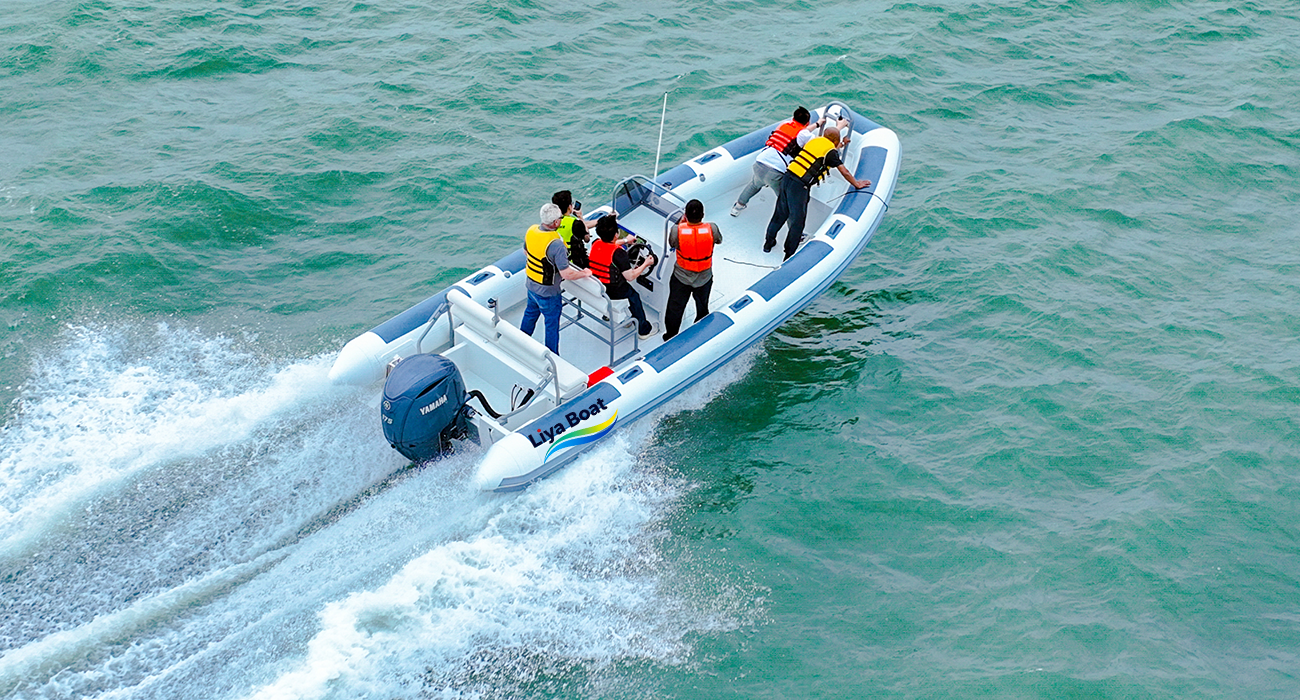
Family-oriented builds prioritize boarding safety and onboard comfort. Key design specifications include a minimum tube diameter of 50–55 cm for lateral stability during boarding from the water, a wide aft swim platform integrated into the transom, and anti-slip deck surfaces across the entire cockpit area. Recessed deck storage for life jackets, flares, and safety equipment should be flush-mounted to prevent trip hazards. For family vessels regularly used by children, grab rails should be welded continuously around the full interior perimeter rather than installed as discrete handle points.
Commercial Dive Platforms (6m – 9m)
Dive boats require specialized deck architecture. A split stern with a centreline entry step allows divers to exit and re-enter in full equipment without climbing over tube sections. Dedicated equipment stations for cylinder racks, regulator hose management, and weight belt storage should be integral to the deck design rather than retrofitted with bolted accessories. Anti-corrosion coatings on all deck hardware are mandatory given continuous immersion of equipment rinsed with salt water.
Search and Rescue (SAR) and Patrol (7m – 12m)
SAR operators require modular deck track systems (typically Bord-Profil 45mm extrusion or equivalent) that allow mission equipment loadout to be reconfigured between operations. Shock-mitigation seating — commonly Ullman Dynamics or Shoxs suspension seats — is standard specification for crews operating at sustained speeds above 25 knots in open water. These seats absorb 60–80% of wave-impact forces that would otherwise reach the crew's lumbar spine. Navigation electronics must be integrated into a fully enclosed, waterproof console rated to IP67 minimum.
Military and Law Enforcement (7m – 11m)
Military-specification RIBsintroduce additional requirements including radar-absorbing topcoat options, night vision-compatible red/white switchable lighting, boarding ladder systems compatible with vessel-to-vessel transfer operations, and communication electronics meeting relevant military specifications. Hull identification markings must comply with relevant naval authority standards. Weapon system mounts, where applicable, must be engineered into the primary hull structure — not surface-mounted — to absorb operational recoil loads safely.
8. Console and Electronics Integration
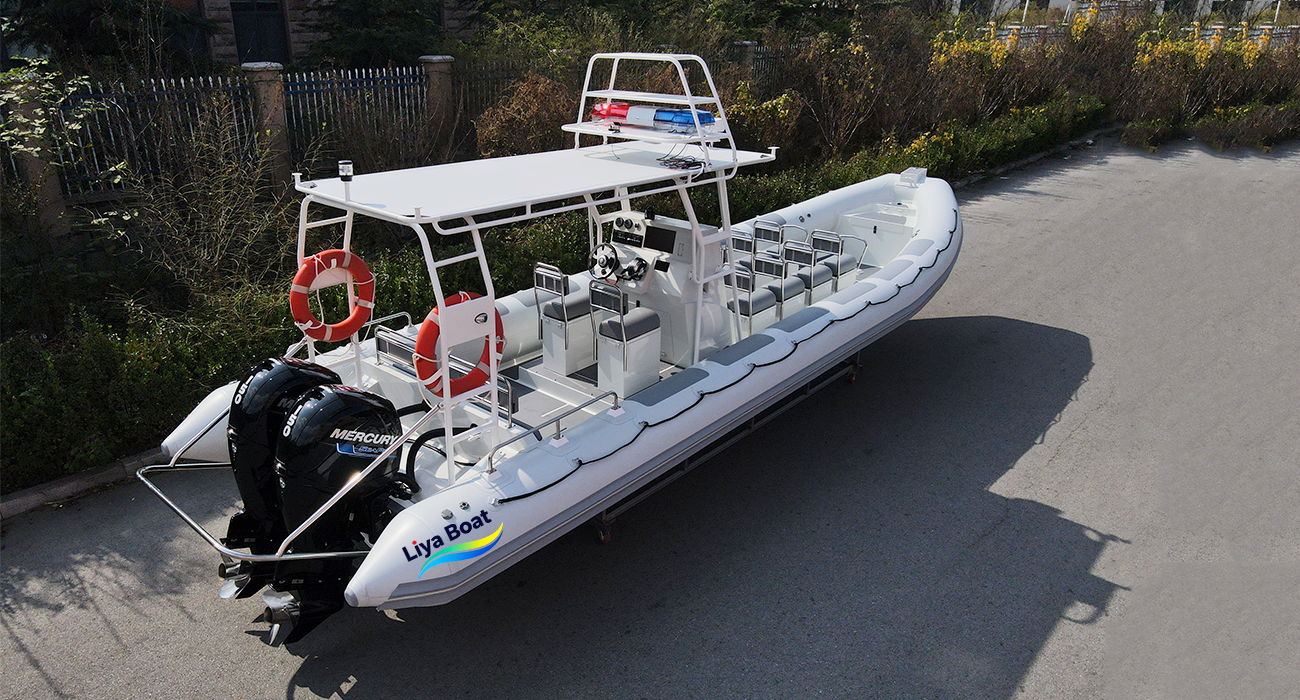
Console design has evolved significantly as electronics packages have grown more sophisticated. A center console layout remains standard for most commercial and SAR applications due to 360° visibility and access to all vessel systems from a single operating position. A side console configuration is preferred for dive boats where the center deck area must remain unobstructed.
Electronics integration in 2025 typically includes multifunction chartplotter/sonar displays (Garmin, Furuno, or Raymarine are the dominant professional marine brands), VHF DSC radio with GPS-linked distress function, AIS transponder for commercial vessels operating in busy shipping lanes, and increasingly, satellite communication terminals for offshore operations beyond VHF range.
Helm wiring should be run in conduit through the hull structure, not surface-routed with cable ties. Every penetration through a bulkhead or deck requires a gland fitting to prevent water ingress. Power distribution panels should be installed with individual breakers for each circuit and a single master disconnect accessible without tools.

9. Engine Selection and Transom Specifications
The transom bracket is engineered to a specific maximum horsepower rating determined by hull length, beam, and weight. Installing an outboard motor exceeding the transom's rated capacity stresses the hull-to-tube connection and can cause catastrophic transom failure under acceleration loads.
For vessels between 5 and 7 meters, single outboard configurations from 70 to 200 HP are typical. Twin outboard installations become practical above 7 meters and are standard for vessels where redundancy is operationally mandatory — SAR, patrol, and charter applications where engine failure is an unacceptable risk.
The major outboard manufacturers each have relevant product lines: Yamaha's F-series four-stroke engines dominate the professional segment for reliability and parts availability globally. Mercury's Verado series is preferred in applications where power-to-weight ratio is the primary specification. Honda's BF series is highly regarded in the commercial fishing and dive industry for low maintenance intervals.
Electric outboard motors are now a viable option for sheltered-water leisure RIBs up to approximately 5 meters. Torqeedo's Deep Blue series and the Mercury Avator 110e provide emission-free operation suitable for marina environments with noise or emissions restrictions. Range limitations at higher speeds remain the constraint preventing wider adoption in commercial and offshore applications as of 2025.
10. Total Cost of Ownership (TCO) Framework
Purchase price represents only 35–50% of the true 10-year cost of operating a custom RIB. The complete TCO calculation must include the following elements.
Initial capital expenditure varies enormously by specification. A basic 5-meter aluminum-hull PVC-tubed leisure RIB starts from approximately $15,000–$25,000 USD ex-factory. A fully specified 9-meter GRP-hulled Hypalon SAR vessel with commercial electronics and twin outboards will exceed $120,000–$180,000 USD. These ranges reflect real market pricing in 2025 from established manufacturers.
Retubing cost is the largest scheduled maintenance expense. A complete tube replacement on a 6-meter vessel using Hypalon fabric costs $8,000–$15,000 USD including labor, depending on tube configuration and regional labor rates. At a 12-year Hypalon tube lifespan, this amortizes to $660–$1,250 USD per year. PVC retubing costs slightly less in materials but occurs at half the interval — net annual cost is frequently higher.
Fuel efficiency is where hull engineering decisions generate ongoing financial impact. A 200 kg reduction in vessel displacement (achievable through aluminum hull and aluminum floor versus GRP) at an average annual usage of 200 hours and fuel consumption of 20 liters/hour can represent savings of 800–1,200 liters of fuel annually — approximately $1,200–$1,800 USD at current prices.
Insurance premiums are directly affected by NMMA, CE, or equivalent certification status. Non-certified vessels may face premium loading of 20–40% or coverage exclusions for commercial use.
11. How to Evaluate a Custom RIB Manufacturer
Shortlisting a manufacturer requires verification beyond marketing materials and website photography. The following evaluation protocol addresses the most common procurement risks.
Request evidence of certification compliance rather than accepting certification claims. Specifically, ask for the CE Declaration of Conformity document for your vessel category, the ISO 6185 test reports for the tube configuration you are purchasing, and the structural warranty terms in writing, separated from the tube fabric warranty.
Inspect fabric material certifications. Genuine Hypalon (CSM) fabrics carry a Trelleborg, Orca Pennel & Flipo, or equivalent manufacturer's certification code woven into the material edge. Ask the builder to show you the fabric roll documentation before manufacturing begins.
Assess production facility capability. Cold-gluing facilities must maintain controlled temperature and humidity. Ask for documentation of the facility's environmental monitoring records. A manufacturer unable to provide this either doesn't control the process or doesn't understand why it matters.
Evaluate lead times against your operational deadline with a margin. Custom manufacturing for a fully specified commercial vessel takes 10–16 weeks from order confirmation at most professional facilities. Quoted lead times shorter than 8 weeks for complex builds should be treated as a risk indicator.
Confirm regional serviceability. The most significant cost and safety risk of owning a Hypalon-tubed RIB in a remote location is finding a technician with proper materials and training for field repairs. Confirm that the manufacturer's dealer or service network includes a qualified facility within your operating region.
12. Maintenance Schedule by Material Type
Proper maintenance is the most cost-effective investment in extending vessel lifespan. The following schedule reflects best practice recommendations from leading manufacturers.
After every use: Rinse tubes and deck surfaces with fresh water. Remove any oil, fuel, or sunscreen residue from tube surfaces — these chemicals accelerate UV degradation and, in the case of petroleum products, can attack PVC plasticizers directly.
Monthly (in-season): Inspect all valve seals for weeping or slow pressure loss. Check seams visually for delamination, particularly at high-stress areas — tube-to-hull attachment points and D-ring attachment patches. Apply UV protectant to PVC surfaces (303 Aerospace Protectant or equivalent). Inspect hardware mounting points for corrosion.
Annually: Perform a 24-hour pressure retention test on each chamber individually. Inflation to rated pressure followed by measurement after 24 hours should show no more than 2–3% pressure loss under stable ambient temperature. Clean and inspect all PRVs. Lubricate valve stems. Check transom bracket fasteners for torque. Inspect hull-to-tube attachment rail for cracks or loosening.
Every 3–5 years: Full resealing of cold-glued seam joints on Hypalon vessels. Re-application of anti-fouling paint on hull bottom where applicable. Full electronics system inspection and software updates.
Frequently Asked Questions
What is the average lifespan of a custom inflatable RIB boat?
Hull lifespan depends on material and maintenance quality. Marine-grade aluminum hulls routinely last 25–30 years. Vacuum-infused GRP hulls last 20–30 years with proper maintenance. Tube lifespan is the limiting factor: Hypalon tubes last 10–15 years in tropical climates and up to 20 years in temperate conditions. PVC tubes last 5–8 years in tropical use and 8–12 years in temperate climates. The combination of a quality hull with scheduled retubing can extend total vessel service life to 30+ years.
How much does a custom RIB boat cost to build?
Custom RIB manufacturing costs range from approximately $15,000 USD for a basic 5-meter leisure configuration to over $200,000 USD for a fully specified commercial or military-grade vessel above 10 meters. The primary cost drivers are hull size, tube material (Hypalon adds 40–60% to fabric cost over PVC), floor specification, electronics package, and engine selection. Always request an itemized quotation to compare manufacturers on equivalent specifications rather than headline price.
Can I upgrade my existing RIB from PVC to Hypalon tubes?
Yes. Retubing with a material upgrade is a standard service offered by most professional inflatable boat repair facilities. The process involves removing the existing tube collar, cleaning and preparing the hull attachment rail, and manufacturing new Hypalon tubes to the original dimensional specification. The structural hull can be retained indefinitely if it shows no fatigue cracking. The upgrade typically costs $8,000–$18,000 USD depending on vessel size, and extends tube lifespan by 5–8 years compared to equivalent PVC replacement.
What tube diameter is optimal for stability on a family RIB?
Tube diameter is proportional to hull length. As a general guideline, a 5-meter hull is typically fitted with 45–50 cm diameter tubes, while a 7-meter hull uses 55–65 cm tubes. Larger diameter increases lateral stability and freeboard, makes boarding from the water easier, and deflects spray more effectively. The practical constraint is that excessively large tubes relative to hull length create aerodynamic drag that reduces top speed and fuel efficiency. Manufacturers use stability modeling software to optimize the tube diameter-to-hull-length ratio for each design.

Welcome To Contact Us

-
 Choosing the hull material is one of the main decisions when buying a rigid-hull inflatable boat. Aluminum and fiberglass are both widely used for RHIBs, and both can support patrol, rescue, workboat, tender and recreational applications.The main differences lie in how the hull is made, how it respo
 -
 Shallow-water operation exposes a boat to risks that are less common on deeper, predictable routes: changing bottom conditions, sandbars, debris, beach landings, floating docks and low-speed contact with shore structures.
 -
 The choice between a 7m and a 10m RHIB is mainly a choice between operating roles. Both are capable Aluminum Hull RIB Boats, but they serve different needs in terms of passenger movement, deck space, route length, equipment integration and crew workflow.